Rules / Playing the Game / When to Roll
When to Roll
When to Roll Dice
Use these questions to decide whether, and how, to roll:
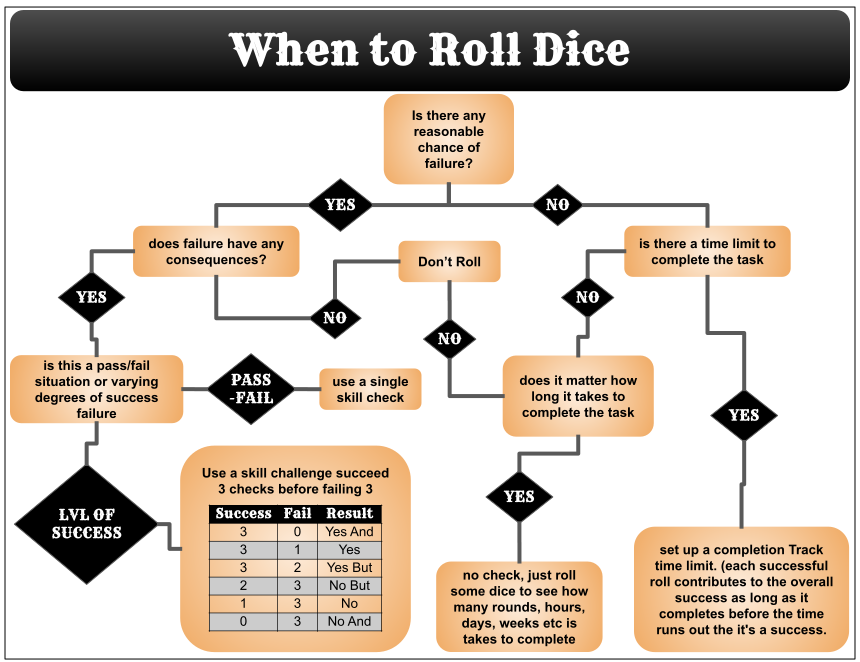
- Is there any reasonable chance of failure?
- Yes: does failure have any consequences?
- No: don't roll.
- Yes: is it a simple pass/fail, or are there degrees of success and failure?
- Pass/fail: make a single skill check.
- Degrees of success: run a Skill Challenge (3 successes before 3 failures).
- No: is there a time limit to finish the task?
- Yes: set up a Completion Track (below): each successful roll or action toward the goal adds progress, and if it's complete before time runs out, the task succeeds.
- No: does it matter how long it takes?
- Yes: no check; just roll some dice to see how many rounds, hours, days or weeks it takes.
- No: don't roll.
- Yes: does failure have any consequences?
Completion Tracks
A Completion Track measures progress toward a goal that takes more than one action to reach, usually against a time limit. It works like a progress clock: the GM draws a track with a number of boxes, names the goal, and the players fill it in as they make headway.
- Size and time limit are the GM's call. A small task might be 4 boxes; a sprawling mystery or a race against an approaching army might be 8, 12 or more. The time limit can be in-world (before the train leaves, before nightfall, before the cult finishes its ritual) or another track that fills as things get worse.
- Each successful action toward the goal adds 1 tick. A critical success adds 2. What counts as a successful action, and what counts as a critical one, is up to the GM.
- A "successful action" doesn't have to be a single roll. It can be as simple as a passed check or a won Skill Challenge, but it can just as well be an open-ended goal achieved in the fiction: gaining someone's trust, finding an artifact, turning up a clue to the mystery. Each of those can take several actions, a whole scene, or even a quest, depending on how big the track is.
- When the track is full, the goal is reached. If time runs out first, it isn't, and the GM says what that costs.
Example: the crew has until the end of the festival to expose the mayor. The GM draws an 8-box track. Winning over the mayor's clerk adds 1 tick; stealing the ledger with a spectacular, unnoticed heist (a critical success, the GM rules) adds 2; uncovering the hidden payments takes a whole session of investigation and adds 1 more. When the eighth box fills, they have enough to bring him down.
Skill Challenge Results
| Successes | Failures | Result |
|---|---|---|
| 3 | 0 | Yes, And |
| 3 | 1 | Yes |
| 3 | 2 | Yes, But |
| 2 | 3 | No, But |
| 1 | 3 | No |
| 0 | 3 | No, And |
The full Skill Challenge rules, with what each result means and the odds by target number, are in Skills.